Loading...
Cold first-floor floors and high heating bills often trace back to an under-insulated basement. We fix that with the right materials for Elmira homes and winters.
Basement insulation in Elmira, NY slows heat loss through foundation walls and the ceiling above your basement, most jobs take one to three days and you can use the rest of your home throughout.
If your first-floor floors feel cold during Elmira winters, or your furnace runs constantly from October through April, an uninsulated or under-insulated basement is often the cause. Most homes in Elmira were built before basement insulation was standard practice, so the gap between what your home has and what it needs can be significant. Pairing basement insulation with vapor barrier installation is common in this area because moisture and heat loss tend to go hand in hand in older Southern Tier homes.
Getting this right means checking for moisture first, choosing the right material for your foundation type, and covering every wall and ceiling bay - not just the easy spots. That is what we do on every job.
If you walk across your kitchen or living room in socks during an Elmira winter and the floor feels noticeably cold, heat is escaping through an uninsulated or under-insulated basement below. This is especially common in Elmira homes built before 1960, where the basement was never insulated to begin with. The fix is often straightforward and makes a dramatic difference in comfort.
If your gas or electric bills have been higher than expected during Elmira's long heating season and nothing has changed in your habits, heat loss through the basement is one of the first places to look. An uninsulated basement can account for a significant portion of your home's total heat loss. A quick assessment can tell you whether the basement is contributing.
A musty odor or white mineral streaks on your concrete walls are signs that moisture is moving through the foundation. This matters because installing insulation over a damp wall traps moisture and creates conditions for mold. If you are seeing these signs - particularly in homes near the Chemung River valley - address the moisture first before insulating.
Many homes in Elmira's established neighborhoods were built when basement insulation was not standard practice. If you go downstairs and see bare concrete or block walls with nothing covering them, you are losing heat every single day of winter. This is one of the highest-return upgrades you can make in an older Elmira home - the improvement in comfort is usually noticeable within the first heating season.
The right approach depends on whether your basement is finished or unfinished, and whether moisture is a factor. For unfinished basements, we typically insulate the perimeter walls with spray foam or rigid foam board - both options stop air infiltration while slowing heat loss through the foundation. Spray foam is a particularly strong fit for older stone and block walls because it seals gaps and resists moisture at the same time. If you are dealing with any dampness, we pair the insulation work with vapor barrier installation to keep moisture from getting trapped behind the new insulation.
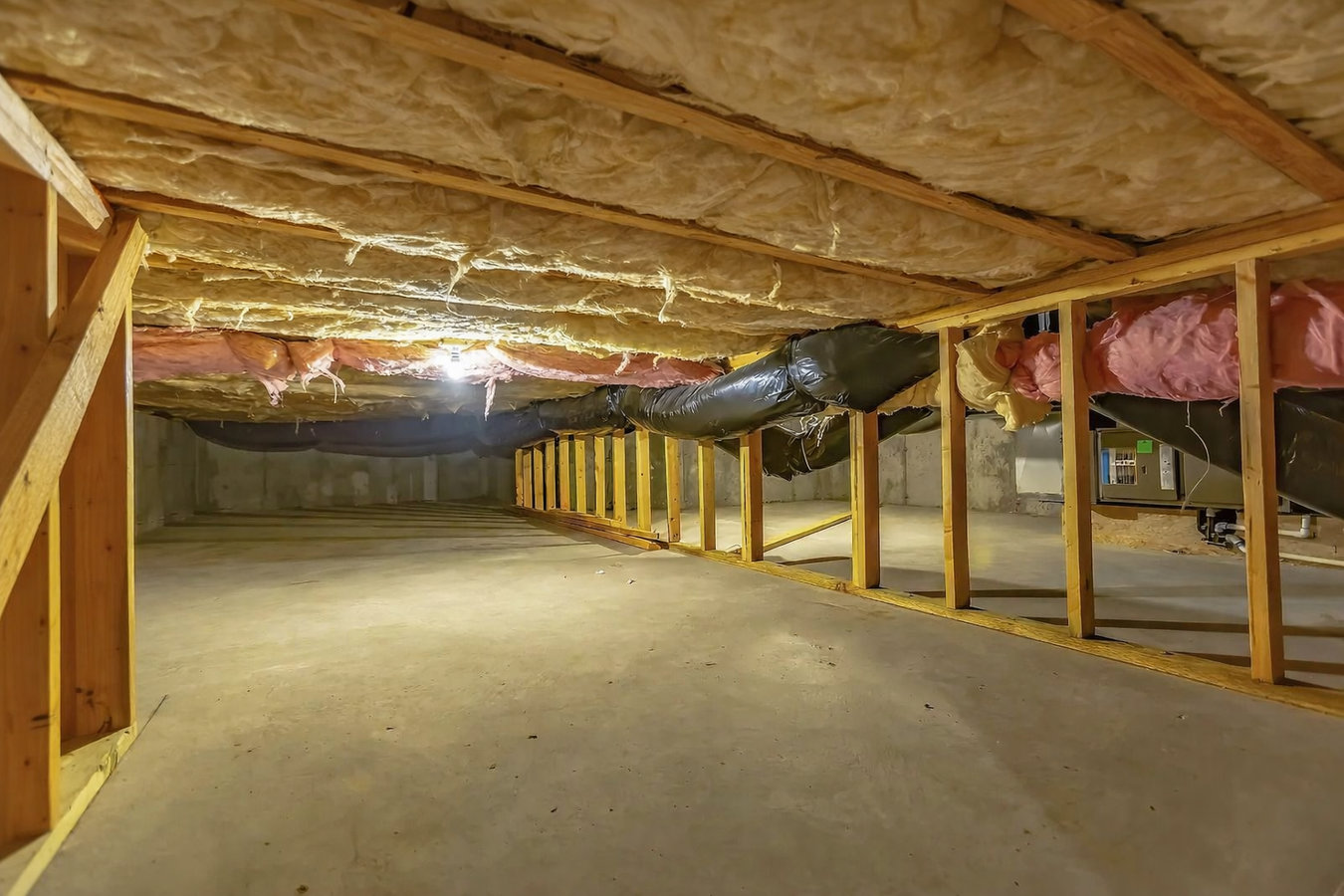
For basements that will stay unheated and unfinished, insulating the ceiling - the underside of your first floor - is often the most cost-effective approach. It keeps your living space warmer without conditioning the basement itself. We also address the rim joist, the area where your floor framing meets the top of the foundation wall. That gap is one of the most common sources of cold air infiltration in older Elmira homes, and sealing it with closed-cell foam insulation makes an immediate difference.
Best for homeowners who want to use the basement as living space or who want maximum protection for the foundation walls and pipes.
Suits homes with an unheated, unfinished basement where the priority is keeping the first floor warm without conditioning the space below.
Ideal for any basement - sealing the rim joist stops cold air infiltration at one of the most common weak spots in older homes.
Every basement job starts with a moisture check - essential for homes near the Chemung River valley or in Elmira's older neighborhoods.
Elmira sits in the Southern Tier of New York, where the heating season runs from October through April and January temperatures regularly drop into the single digits. Your basement walls are exposed to extreme cold for more than half the year. Contractors working here typically recommend higher insulation levels than national averages suggest - and that recommendation reflects the reality of what local homeowners experience every winter. A large share of Elmira's housing stock dates from the early 20th century, when basement insulation was not part of how homes were built, which means the potential improvement is significant even with a basic upgrade. Homeowners in Horseheads and Big Flats face the same seasonal pressures and old-stock challenges as Elmira proper.
Elmira also has a history of moisture challenges tied to the Chemung River. Homes near lower elevations in the city can see basement water intrusion after heavy rain or snowmelt, which means any basement insulation project here needs to start with a careful moisture check. Insulating over a damp wall without addressing the water first is one of the most common and costly mistakes homeowners make - and it is exactly what we look for before we recommend any approach. New York State's energy programs through NYSERDA offer rebates for qualifying basement insulation work, which can meaningfully reduce your upfront cost.
We will respond within one business day. We ask a few quick questions - basement size, whether it is finished, and any moisture history - so we come prepared with the right materials and realistic expectations.
We walk your basement, check for moisture, look at existing insulation, and measure the space. You get a written estimate before any work is agreed to - no pressure to decide on the spot.
The crew works entirely in your basement. Most of the activity stays below ground level, so your daily routine upstairs is not disrupted. If spray foam is used, we ventilate the space and walk you through the re-entry window before we start.
When the work is done, we walk you through what was installed and where. You leave knowing exactly what was done - useful for NYSERDA rebate applications and future home inspections.
Free estimate. We check for moisture before we recommend anything. No pressure.
(607) 302-4623We inspect for water intrusion before recommending any material - a step many contractors skip. In Elmira's older homes and lower-lying neighborhoods near the Chemung River, that check protects you from insulating over a problem that will only get worse.
Elmira homes often have stone or older concrete block foundations that need different treatment than modern poured concrete. We work on these homes regularly and know what approaches hold up over the long Southern Tier heating season.
New York State offers rebates for qualifying basement insulation projects through NYSERDA. We help you understand what is available before you commit, so you are not leaving money on the table. ENERGY STAR-aligned materials used on qualifying work may also be eligible for federal tax credits.
You receive a clear written estimate that details the area being treated, the material being used, and the total cost. No verbal agreements, no surprises on installation day - just a straightforward record you can rely on.
Every proof point above comes down to one thing: doing the job in a way that holds up through years of Elmira winters. We have built our reputation on that standard, and it is what homeowners in this area call us back for.
High-density spray foam that insulates and air-seals in one pass - a common choice for rim joists and basement walls in older Elmira homes.
Learn MorePlastic sheeting installed on the warm side of insulation to prevent moisture from getting trapped inside your walls or floor assembly.
Learn MoreElmira's heating season starts early - get your home ready before the cold sets in and the schedule fills up.